The Best Ways to Invest Money in 2026

Smart, Proven Strategies to Build Real Wealth (Ranked & Explained
If you want to build wealth in 2026, investing isn’t optional—it’s essential.
But here’s the problem: most advice is either too basic (“just save money”) or too risky (“buy random crypto”). What actually works sits in the middle: proven assets, disciplined strategy, and consistency over time.
This guide breaks down the best investment options the way a serious investor would—ranking them by returns, risk, accessibility, and long-term growth potential—and giving you a clear plan you can follow.
Download Free Wealth Guide
🏆 Our Top Picks
- Best Overall: Index Funds
- Best for Cash Flow: Real Estate
- Best for High Growth: Stocks (Individual Picks)
- Best Passive Strategy: REITs
- Best Alternative Asset: Digital Businesses
💡 How We Chose
Every investment here was evaluated using four key criteria:
Risk Level – How much volatility and downside you can expect
Return Potential – Long-term upside based on historical data and trends
Passive Income – Whether it pays you regularly
Ease of Entry – How realistic it is for beginners to start
We also prioritized assets that compound over time, not just quick wins.
Get my weekly business & investing strategies” 👉 This is where the money starts
🥇 1. Index Funds (Best Overall Investment)
Why We Recommend It
If you want a simple, proven way to build wealth, index funds are the gold standard.
They track the overall market—meaning you’re investing in hundreds (or thousands) of companies at once. Instead of trying to pick winners, you own the market itself.
Examples
• S&P 500 index funds
• Total market index funds
Pros
✔ Low risk (compared to individual stocks)
✔ Historically consistent returns (8–10% annually over time)
✔ Completely passive
✔ Beginner-friendly
Cons
✘ Slower growth than aggressive investments
✘ Can feel “boring” compared to trend investing
How to Start
1. Open a brokerage account
2. Set up automatic monthly investments
3. Reinvest dividends
Bottom Line
Perfect for long-term, stress-free wealth building. This should be the foundation of almost every portfolio.
🥈 2. Real Estate (Best for Cash Flow)
Why We Recommend It
Real estate creates two powerful income streams:
- Monthly cash flow
- Long-term appreciation
It’s one of the few investments where you can use leverage (borrowed money) to increase returns.
Examples
- Rental properties
- Short-term rentals (Airbnb)
- Multi-family units
Pros
✔ Monthly income
✔ Tax advantages (depreciation, write-offs)
✔ Property value increases over time
✔ Ability to scale with financing
Cons
✘ Requires upfront capital
✘ Management effort (unless outsourced)
✘ Market-dependent
Pro Strategy
Start with one property → refinance → use equity to buy more.
This is how many investors build large portfolios.
Bottom Line
One of the most reliable ways to build financial independence and consistent income.
🥉 3. Individual Stocks (Best for High Growth)
Why We Recommend It
If you pick strong companies, your returns can significantly outperform the overall market.
This is where investors generate outsized gains—but it requires knowledge and discipline.
Examples
Tech companies
Growth stocks
Dividend-paying companies
Pros
✔ High return potential
✔ Ownership in real businesses
✔ Easy to buy and sell
Cons
✘ Higher risk
✘ Requires research and emotional control
Smart Approach
Focus on industries you understand
Hold long-term instead of trading
Avoid hype-driven decisions
Bottom Line
Best for investors willing to learn, analyze, and take calculated risks.
💸 4. REITs (Real Estate Investment Trusts)
Why We Recommend It
REITs allow you to invest in real estate without owning physical property.
They pay out most of their profits as dividends, making them attractive for income investors.
Pros
✔ Passive income (regular dividends)
✔ No property management
✔ Easy to invest (just like stocks)
Cons
✘ Less control than owning property
✘ Sensitive to interest rates and markets
Best Use Case
Use REITs to supplement real estate exposure without heavy capital or effort.
Bottom Line
A great hands-off real estate strategy for passive investors.
🌐 5. Digital Businesses (Most Underrated Asset)
Why We Recommend It
Buying or building online businesses is one of the fastest-growing investment trends.
Unlike traditional assets, digital businesses can scale quickly with low overhead.
Examples
• Blogs
• E-commerce stores
• SaaS platforms
Pros
✔ High scalability
✔ Monthly recurring income potential
✔ Can be sold for large multiples
Cons
✘ Requires skill and learning
✘ Not fully passive initially
Real Advantage
You control growth—unlike stocks or real estate, you can actively increase revenue.
Bottom Line
This is where modern entrepreneurs are building wealth fastest.
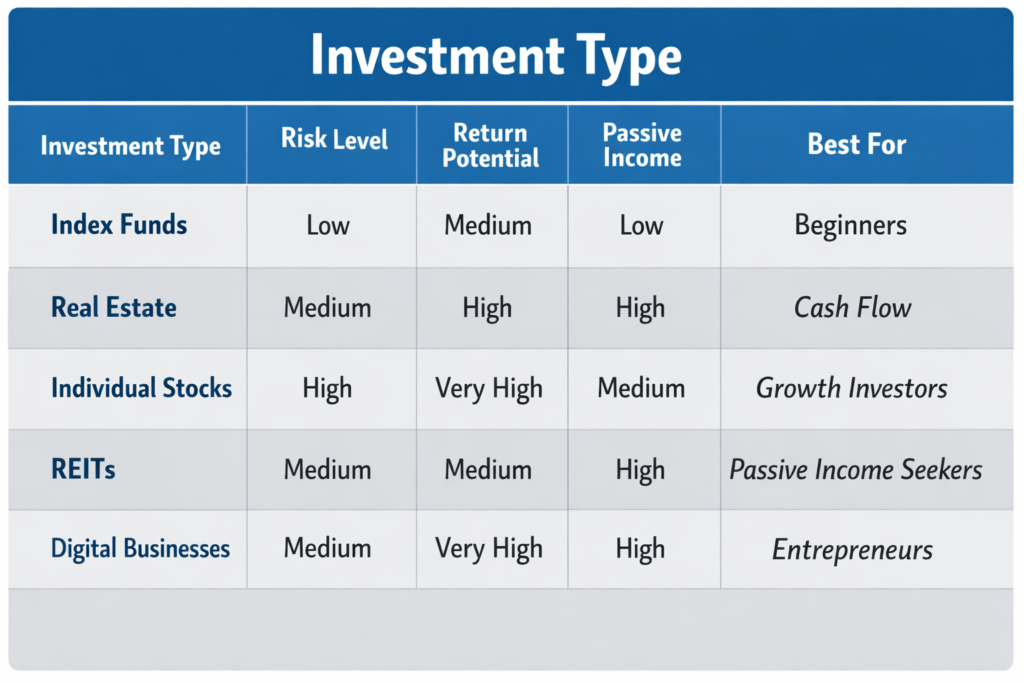
📊 Comparison Table
🧩 Sample Portfolio (Simple & Effective)
If you’re unsure how to combine these, here’s a practical allocation:
50% Index Funds
20% Real Estate / REITs
20% Individual Stocks
10% Digital Businesses or High-Risk Plays
This balances:
Stability
Growth
Cash flow
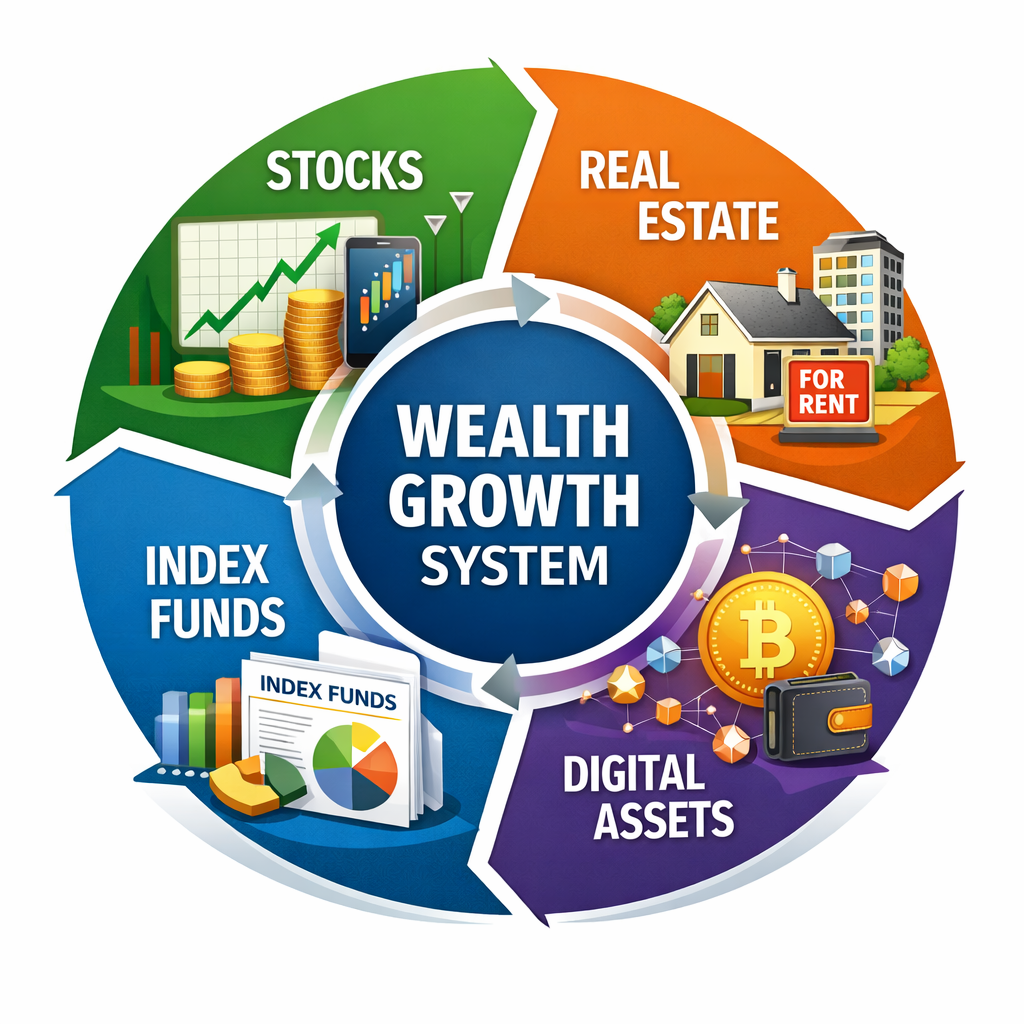
🚀 Our Recommended Strategy
If you want a clear roadmap:
👉 Start with index funds (foundation)
👉 Add real estate (cash flow)
👉 Allocate some to stocks or digital businesses (growth)
👉 Reinvest profits consistently
Over time, this creates a portfolio that:
•Grows steadily
•Generates income
•Compounds aggressively
⚠️ Biggest Investing Mistakes to Avoid
- Trying to get rich quickly
Investing without understanding the asset
Panic selling during downturns
Not diversifying
Waiting too long to start
🧠 Pro Tip (What Smart Investors Do)
They focus on systems, not emotions.
Invest consistently (monthly)
Ignore short-term noise
Think in decades, not days
Wealth isn’t built in one big move—it’s built through small, repeated decisions.
✉️ Final Thought
You don’t need to be perfect—you just need to start.
The earlier you invest, the more powerful compounding becomes.
Your future wealth will depend less on timing—and more on consistency, patience, and smart allocation.